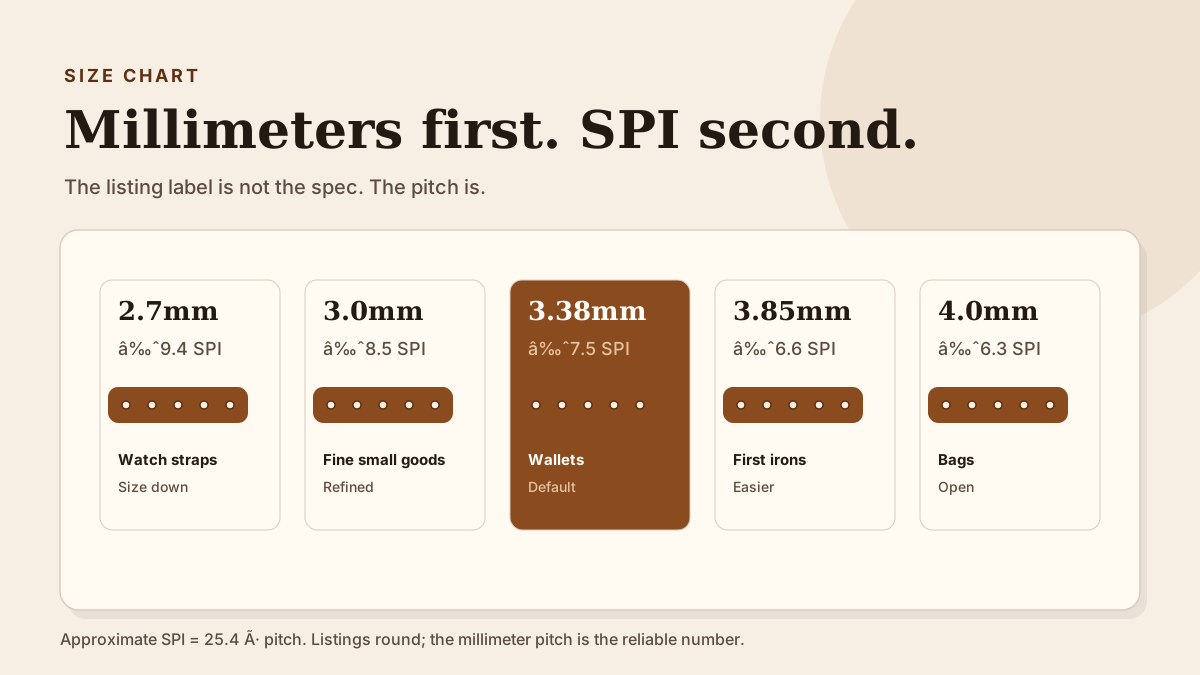
Part of: best pricking irons.
A 3.38mm pricking iron is 7.5 SPI, not 8.5. The exact conversion is 25.4 ÷ pitch, and the rounded labels sellers use can drift from the math. This pricking iron size chart lists the common French-style pitches from 1.93mm to 6mm, the SPI label each pitch carries, the projects each pitch suits, a tooth-count table, and the brand caveat that explains why two 3.38mm irons can leave different marks.
Built from published sizing references, crafter threads, and a verified AliExpress listing (November 7, 2026). This is research, not bench testing.
Pricking Iron Size Chart: mm to SPI
| Pitch (mm) | SPI (25.4 ÷ pitch) | Commonly called | Typical projects | Notes |
|---|---|---|---|---|
| 1.93 | 13.2 | 13 | Fine watch straps, silk-style work | Rare |
| 2.25 | 11.3 | 11 | Fine small goods | Rare |
| 2.45 | 10.4 | 10 | Fine watch straps | Niche |
| 2.70 | 9.4 | 10 | Watch straps, cardholders | Convention overshoots here |
| 3.00 | 8.5 | 9 | Refined wallets, pattern work | Rounds to 8.5 |
| 3.38 | 7.5 | 8 | Wallets, general small goods | The default wallet pitch |
| 3.85 | 6.6 | 7 | Wallets to bags | Armitage's beginner recommendation |
| 4.00 | 6.4 | 6 | Bags, rustic wallets | Rounds to 6 |
| 4.50 | 5.6 | 6 | Belts, heavy goods | Convention rounds up |
| 5.00 | 5.1 | 5 | Belts | — |
| 5.40 | 4.7 | 5 | Heavy belts and straps | Uncommon |
| 6.00 | 4.2 | 4 | Heavy work | — |
SPI values are rounded to one decimal; the formula is exact.
How to Read This Chart
Pitch is the tooth-to-tooth spacing in millimeters. SPI — stitches per inch — is 25.4 ÷ pitch: 3.38mm gives 7.5 SPI, and 3.85mm gives 6.6. Check the math on any calculator.
The "commonly called" column is marketplace shorthand. Sellers round 7.5 up to "8 SPI" and 6.6 up to "7 SPI." No industry body standardizes these labels, so the millimeter pitch is the fact; the SPI label is a convention.
One convention explains the third column. A widely quoted 2018 r/Leathercraft mapping (86b5vd) gives 2.70mm→"10," 3.00mm→"9," 3.38mm→"8," 3.85mm→"7," 4.50mm→"6," 5.40mm→"5." Other rows use the same nearest-whole shorthand. It is convention, not arithmetic — 2.70mm is 9.4 SPI, which normally rounds to 9.
A separate error sits outside this table: Borderland Leather lists 3.38mm as ≈8.5 SPI. Exact math gives 7.51, which rounds to 7.5. Note that 3.00mm rounds to 8.5 SPI — the error belongs to their 3.38mm row, and it keeps getting copied.
What Each Pitch Is For
2.7mm–3.0mm: fine small goods. Kevin Lee Tools' spacing table pairs 1.2–2.2mm leather with 2.7, 3.0, and 3.38mm pitches. That covers watch straps, cardholders, and dressy small pieces; 3.0mm is the refinement step up from 2.7.
3.38mm: the wallet default. For wallets and general small goods, this is the one-pitch answer. The full pitch, thread, and tooth recipe is in our what size pricking irons for wallets guide.
3.85mm: the all-rounder. Wallets still work, bags work better, and the holes tolerate 0.55–0.8mm thread. Nigel Armitage's published beginner guidance points to 7 SPI — 3.85mm — for the same forgiveness reason. Our 3.38mm vs 3.85mm comparison has the side-by-side.
4.0mm–4.5mm: bags and belts. The line reads at a distance and the holes take heavier thread. 4.5mm is belt territory.
5.0mm and up: heavy work. Belts, straps, and thick stacks; fewer stitches per inch and a more open look.
How Many Teeth Do You Need?
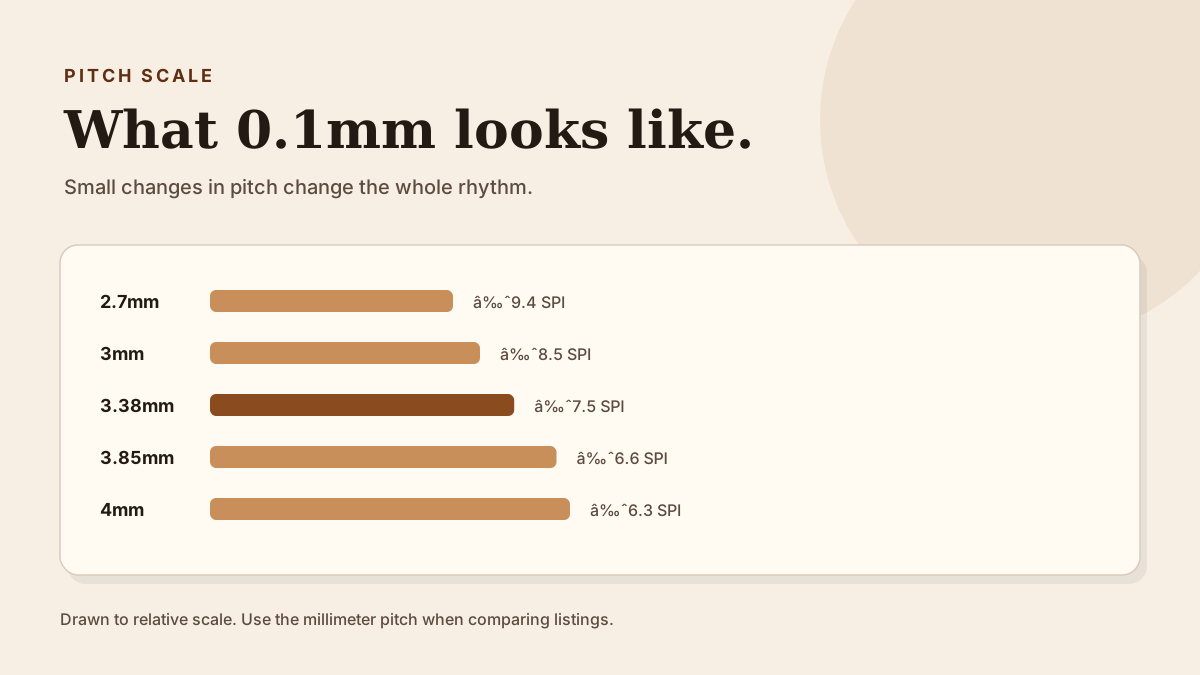
Tooth count changes how much line you mark per press, not the stitch spacing.
| Teeth | Main use | Beginner priority |
|---|---|---|
| 1 | Corners and small adjustments | Low |
| 2 | Curves, corners, finishing | High |
| 5–6 | General runs | Medium |
| 8 | Straight panel runs | High |
| 20 | Belts and long runs | Later upgrade |
Start with 2 + 8 in one pitch. The 2-tooth turns corners; the 8-tooth covers panel runs. British Leather Supplies' guide says 2-, 4-, and 6-tooth irons cover most needs; WUTA's own guide assigns 2 teeth to curves, 5–6 to general work, and 8–20 to long runs. One & Awl notes many makers get by with a 2-tooth plus a 4–8-tooth, which matches the pair we recommend. The budget listing we cite sells 2, 5, and 8 teeth, so 2 + 8 is the practical version of that advice.
More teeth need more force. One & Awl's reference notes that very long rows may want a press rather than a mallet; on a 20-tooth iron, use a firm surface and a controlled strike.
Popular Sizes Compared
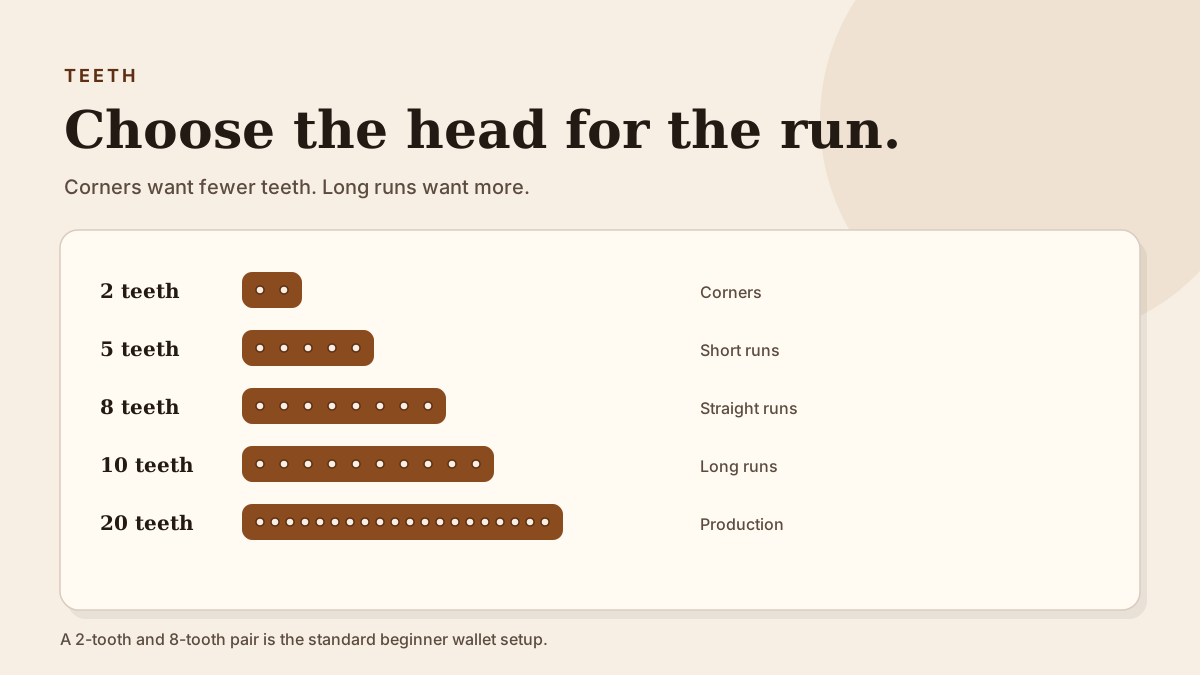
3.38mm vs 3.85mm is the choice most buyers face.
| 3.38mm | 3.85mm | |
|---|---|---|
| SPI | 7.5 | 6.6 |
| Common label | 8 SPI | 7 SPI |
| Best for | Wallets, cardholders, refined small goods | Wallets, bags, thicker thread |
| Usual thread | 0.3–0.55mm | 0.55–0.8mm |
The visual gap is small; hole size and thread weight do more than 0.47mm of spacing. Our 3.38mm vs 3.85mm pricking irons comparison goes deeper.
Brand Caveat: Same Pitch, Different Mark
Pitch is nominal. Two irons sold as 3.38mm can leave different marks because tooth width and tip geometry vary by brand. Borderland Leather makes this point in its own sizing intro, and it is the caveat every chart needs: the millimeter number fixes spacing, not hole size.
What that means in practice:
- A wider tooth opens a bigger hole at the same pitch, which changes how thick a thread fits.
- A sharper, more polished tip cuts cleaner; a blunt one can tear fibers.
- Mixing brands mid-project can show as a changed stitch rhythm, even at the same pitch.
Judge a listing by its tooth photo and measured specs, test on scrap, and do not assume a "3.38mm" from one maker matches another.
Print-Friendly Version
This page is built to print. Use your browser's print command and choose landscape so the five-column table fits; the main table is plain HTML, not an image, so the text stays sharp. For a one-page reference, print the main chart and the tooth table together.
Affiliate disclosure
Awl & Stitch is reader-supported. If you buy through links on this page, we may earn a commission at no extra cost to you. We never accept payment for rankings. How we make money
Get a Pitch From This Chart
The WUTA 1-piece French-style iron (listing 32856254322) covers the four small-goods pitches from 2.7mm to 3.85mm, obverse or reverse, in 2, 5, or 8 teeth. The default variant (3.0mm, 2 teeth) is $14.79 at time of writing (verified November 7, 2026), with free USPS shipping from a US warehouse in 3–10 days. Variant prices differ by pitch and tooth count, and the wider pitches on this chart come from other listings — this one is the budget path into the wallet range, not a universal set.
Check price on AliExpress — choose 2.7, 3.0, 3.38, or 3.85mm from the variant menu (affiliate link, opens in a new tab) Price verified Nov 7, 2026 — variant prices differ by pitch and tooth count, and prices may change.
FAQ
What SPI is a 3.38mm pricking iron?
7.5 SPI (25.4 ÷ 3.38 = 7.51, rounded to one decimal). Sellers commonly call it 8 SPI. If a chart lists 3.38mm as 8.5, it is wrong — the error appears in at least one otherwise-useful table.
What SPI is a 3.85mm pricking iron?
6.6 SPI (25.4 ÷ 3.85 = 6.59, rounded to one decimal), commonly called 7 SPI. Nigel Armitage's beginner recommendation is 7 SPI, which matches this pitch.
What do 2.7mm and 3.0mm suit?
Fine work: watch straps, cardholders, and refined small goods. Kevin Lee Tools pairs 1.2–2.2mm leather with 2.7–3.38mm pitches. Use 2.7mm on narrow straps and 3.0mm for a fine line with more room.
How many teeth should my first iron have?
Two and eight in one pitch. The 2-tooth handles curves and corners; the 8-tooth covers straight runs. British Leather Supplies says 2-, 4-, and 6-tooth irons cover most needs; WUTA's guide assigns 2 teeth to curves, 5–6 to general work, and 8–20 to long runs. Our budget pick sells 2, 5, and 8, so 2 + 8 is the practical pair.
Do more teeth need more force?
Yes. More teeth mean more leather contact per press. One & Awl notes that very long rows may need a press rather than a mallet. With a 20-tooth iron, use a firm surface and a controlled strike, and expect to work in sections on thick leather.
Sources
- Borderland Leather sizing intro — mm↔SPI table, including the 3.38 ≈ 8.5 entry corrected above and the brand caveat (accessed November 7, 2026)
- r/Leathercraft thread 86b5vd (opens in a new tab) (2018) — widely quoted rounded mm/SPI mapping (accessed November 7, 2026)
- WUTA official tooth-count guide (September 4, 2026) — tooth-count uses (accessed November 7, 2026)
- British Leather Supplies pricking-iron guide (October 15, 2025) — teeth ranges and spacing bands (accessed November 7, 2026)
- Kevin Lee Tools spec page — pitch list and project/thickness mapping (accessed November 7, 2026)
- One & Awl reference (2024) — teeth flexibility and force note (accessed November 7, 2026)
- Armitage Leather review PDF (January 2020) — SPI examples and beginner guidance (accessed November 7, 2026)
- lwleatherworking.com (January 6, 2026) — spacing bands by project (accessed November 7, 2026)
- AliExpress listing 32856254322 (affiliate link, opens in a new tab) — variant menu, default-variant price, US-warehouse USPS shipping (accessed November 7, 2026)
Last updated: November 7, 2026. Changelog: Nov 7, 2026 — first publish; SPI values recomputed from 25.4 ÷ pitch and listing data verified.