Part of: best pricking irons for beginners.
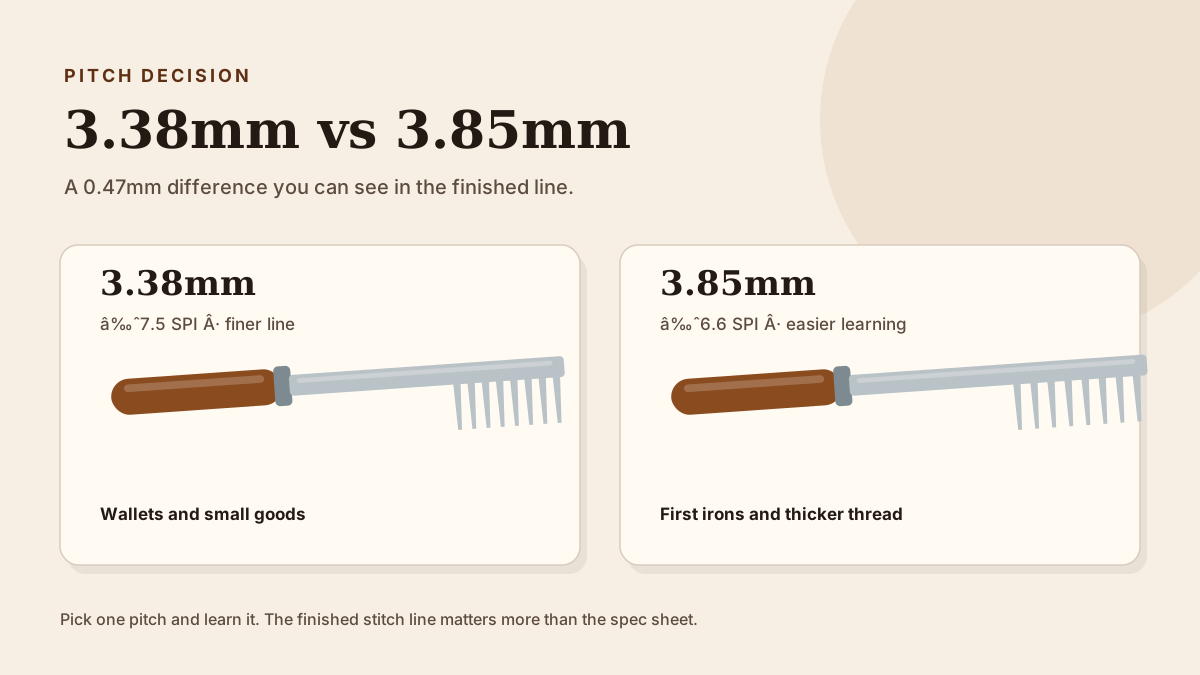
Buy 3.38mm if you stitch small, refined goods — wallets, cardholders, journal covers — or if you want one size for everything. Buy 3.85mm if you make larger items, sew thicker thread, or want the more forgiving learning curve that leathercraft educator Nigel Armitage recommends for beginners. Both pitches are common variants on the same budget listings, so this is a checkout-menu decision, not a brand decision. The honest caveat first: the visual difference is subtle, and hole size plus thread weight drive the look of a saddle stitch more than 0.47mm of spacing does.
Everything below is drawn from cited crafter threads, published sizing references, and listing data verified on the AliExpress US storefront on November 7, 2026 — not from bench time.
Affiliate disclosure
Awl & Stitch is reader-supported. If you buy through links on this page, we may earn a commission at no extra cost to you. We never accept payment for rankings. How we make money
Quick Answer: 3.38mm vs 3.85mm Pricking Irons
- 3.38mm — finer stitch lines, the standard for small leather goods, and the majority pick among crafters who own only one size.
- 3.85mm — roomier holes for 0.55–0.8mm thread, faster stitching on bigger panels, and the beginner recommendation attributed to Nigel Armitage (7 SPI).
- Neither is wrong. In a 2023 r/Leathercraft thread on iron sizes for wallets, one commenter put it plainly: "we are literally talking about tenths of millimeters."
What the Numbers Actually Mean
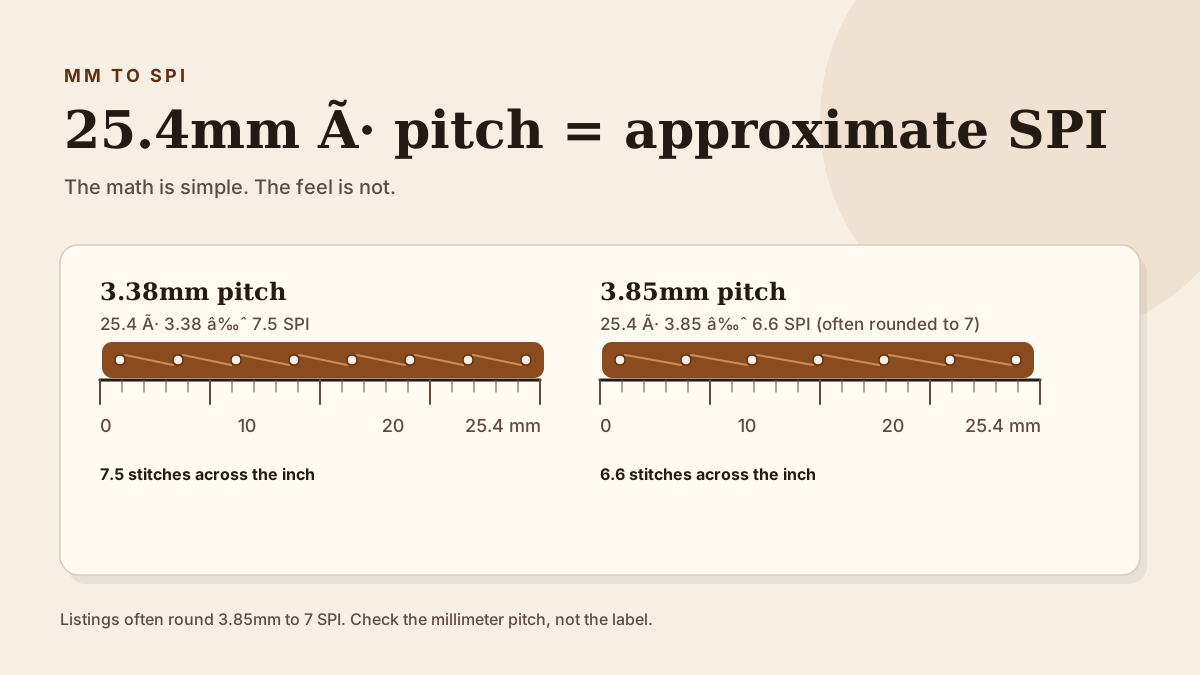
The number is the pitch: the tooth-to-tooth spacing in millimeters. Stitches per inch (SPI) is just the inch conversion — 25.4 ÷ pitch:
- 25.4 ÷ 3.38 = 7.5 SPI, commonly rounded up and sold as "8 SPI"
- 25.4 ÷ 3.85 = 6.6 SPI, commonly rounded down and sold as "7 SPI"
Why the odd sizes? Because uneven millimeter spacing tracks true SPI better than round numbers do — that is the explanation offered in a 2018 r/Leathercraft thread on French prong spacing, where commenters map mm sizes to SPI directly. One correction worth making: a widely shared sizing chart from Borderland Leather lists 3.38mm as ≈8.5 SPI; the exact math is 7.5. If a chart's SPI column looks off, trust the division. Our full pricking iron size chart does the conversion for every common pitch.
Side-by-Side Comparison
| 3.38mm | 3.85mm | |
|---|---|---|
| Exact SPI (25.4 ÷ pitch) | 7.5 | 6.6 |
| Commonly called | 8 SPI | 7 SPI |
| Stitch look | Finer, denser, "refined" | Slightly longer, more open, "rustic-refined" |
| Best projects | Wallets, cardholders, journal covers, passport holders | Totes, briefcases, bag panels, belts |
| Thread pairing | 0.3–0.55mm | 0.55–0.8mm |
| Hole size character | Smaller holes; less margin for thick thread | Larger holes; accommodates heavier thread |
| Beginner friendliness | Good, but less forgiving with thick thread | Better — Armitage's cited beginner rec |
| Versatility note | The majority "one-size-forever" answer | Better resale demand among bag makers |
Pick by project
| Project | Recommended pitch |
|---|---|
| Wallets / cardholders | 3.38mm — see what size pricking irons for wallets |
| Journal covers / passport holders | 3.38mm |
| Belts / straps | 3.85mm or larger |
| Bags / heavy goods | 3.85mm or larger |
Stitch Look: Refined vs Rustic
At the same thread weight, 3.38mm produces a denser line with more slants per inch; 3.85mm reads slightly longer and more open. Descriptions like "refined" versus "rustic" come from crafter threads and maker diagrams, not from our own bench. What the same 2023 wallet-size thread makes clear is that the pitch difference alone is subtle — hole diameter and thread thickness change the look more than the 0.47mm spacing gap does. If you want a visibly finer stitch, dropping thread size often does more than dropping pitch.
Thread Pairing for Each Size
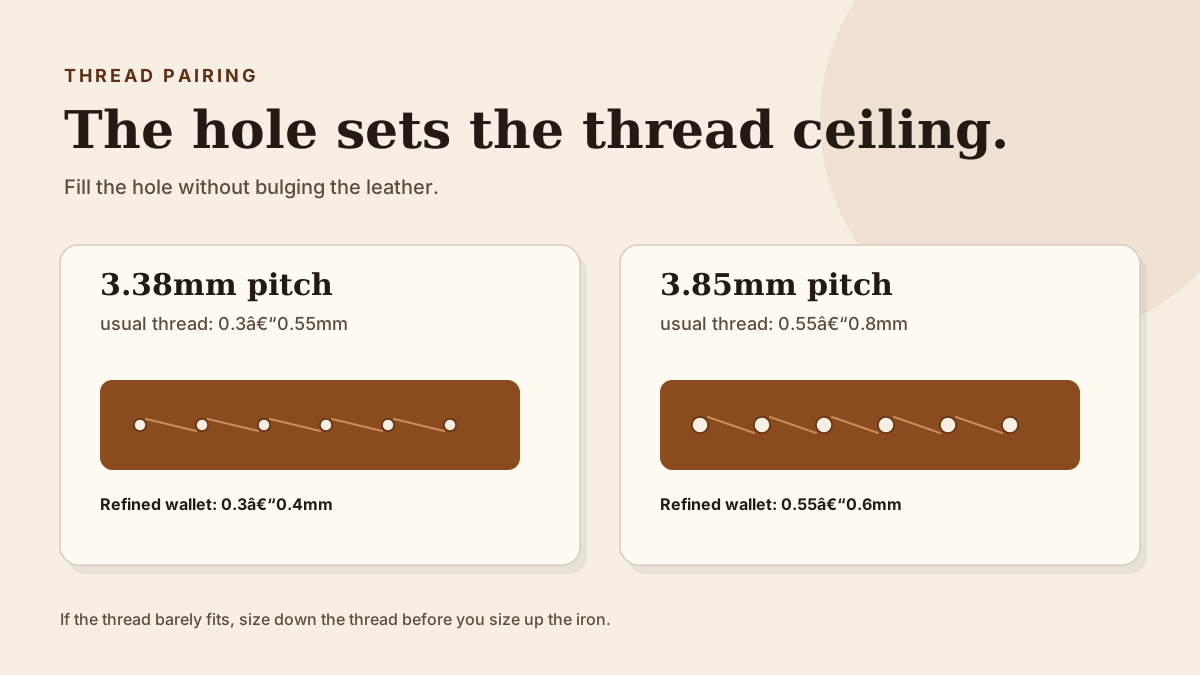
The commonly cited pairings:
- 3.38mm: 0.3–0.55mm thread. For fine small-goods work, a commenter in the 2023 wallet-size thread (under a Sinabroks sizing discussion) reports 3.38mm pairing well with 0.3–0.4mm thread.
- 3.85mm: 0.55–0.8mm thread. In a December 2021 r/Leathercraft thread on 3.85mm irons, the crafter who started it reports using thread at or under 0.55mm with that pitch — a reminder that personal pairing varies; treat these as conventions, not rules.
Thread families that come up in these threads include braided polyester types such as Vinymo and Ritza Tiger thread. A dedicated guide to what thread for pricking irons works best is coming soon.
Which One for Your Project?
- Wallets and cardholders: 3.38mm. In the February 2026 r/Leathercraft thread on French iron sizes, crafters recommend 3.38mm for small goods while noting 3.85mm works fine too; in the 2023 Sinabroks thread, a commenter calls 3.38mm "a great size for what you want" — the asker was choosing a size for wallets.
- Belts and bags: 3.85mm or larger. The longer pitch handles thicker thread and reads better at scale.
- Watch straps: neither. Fine strap work drops to 2.7–3.0mm; both sizes here would look coarse on a 18–20mm strap.
What Crafters Actually Use
The best available data point is anecdotal but telling: in a 2023 r/Leathercraft thread, a crafter with a large Instagram following (around 65K followers at the time) commented that roughly 90% of the wallet makers in their survey used 3.38mm, 3.85mm, or 4mm. Report that as exactly what it is — one crafter's survey comment with an unspecified sample size, not industry data. Around it, the threads agree on the pattern: 3.38mm and 3.85mm (plus 4mm) cover the overwhelming majority of small-goods and bag work, which is why both pitches appear on nearly every French-style listing.
A December 2025 thread debating 3.85mm adds the dissenting note: some makers find even 3.85mm too coarse for their taste in small goods and settle on 3.0–3.38mm only.
Can You Own Just One?
Yes — and this is the question the threads answer most directly. In the February 2026 thread, the majority-leaning answer is: "if I had to pick only one size to use for everything, I'd go 3.38 mm." The counterpoint comes from Nigel Armitage's beginner guidance, relayed in an April 2026 r/Leathercraft thread: start at 3.85mm (7 SPI), because the larger holes are more forgiving while you learn stitch tension and consistency.
Both answers are defensible because they optimize for different things: 3.38mm optimizes for the finished look on small goods; 3.85mm optimizes for learning ease and bigger projects. If your first projects are wallets, follow the majority; if they are totes or belts, follow Armitage.
Where to Buy Both Sizes
The cheapest way to own either pitch is the WUTA 1-piece French-style iron (listing 32856254322): $14.79 for the default variant at time of writing (verified November 7, 2026), with 2.7, 3.0, 3.38, and 3.85mm pitches available as variants in 2, 5, or 8 teeth, obverse or reverse. Shipping we verified: free USPS from a US warehouse, 3–10 days.
👉 Check price on AliExpress — pick your pitch in the variant menu (affiliate link, opens in a new tab) Price verified Nov 7, 2026 — variant prices differ by pitch and tooth count.
For long straight runs in either pitch, the WUTA 20-tooth iron (listing 1005005065670235) covers 3.0, 3.38, and 3.85mm at $103.19 at time of writing (verified November 7, 2026), with free standard shipping in 5–13 days.
👉 Check price on AliExpress (affiliate link, opens in a new tab) Prices verified November 7, 2026 — they change often.
Working with a tight budget? Our best budget pricking irons guide ranks the under-$30 tier and explains the real landed cost.
FAQ
Is 3.38mm or 3.85mm better for wallets?
3.38mm, per the crafter consensus: the February 2026 r/Leathercraft thread recommends it for small goods, and a commenter in the 2023 Sinabroks sizing thread calls 3.38mm "a great size" for wallet work. 3.85mm remains a fine choice if you prefer a slightly more open stitch or already own it.
Why the odd sizes — are they imperial conversions?
They are SPI conversions, done properly. 25.4 ÷ 3.38 = 7.5 SPI and 25.4 ÷ 3.85 = 6.6 SPI; a 2018 r/Leathercraft thread explains that uneven millimeter spacing approximates true stitches-per-inch better than rounded sizes. Watch out for one circulating error: 3.38mm is 7.5 SPI, not 8.5.
What thread works with each size?
Common pairings: 0.3–0.55mm thread with 3.38mm, and 0.55–0.8mm with 3.85mm. Individual crafters vary — one December 2021 thread reports 3.85mm used with thread at or under 0.55mm — so treat the pairings as starting conventions.
If I can only buy one size, which?
The majority answer in the February 2026 thread is 3.38mm as the one-size-forever pick. Nigel Armitage's beginner recommendation, relayed in an April 2026 thread, is 3.85mm/7 SPI. Choose 3.38mm for small-goods output, 3.85mm for learning ease and larger projects.
Is the difference even visible?
Barely, at a glance — a 2023 commenter's "tenths of millimeters" line is fair. Pitch sets the stitches-per-inch rhythm, but hole size and thread weight drive most of the perceived look. If the two sizes look identical in product photos, that is expected.
Verdict
For a first French-style iron: 3.38mm if wallets and small goods are the goal or you want one size for everything; 3.85mm if you are learning on larger projects or plan heavier thread. Since both ship as variants of the same $14.79 WUTA listing (verified November 7, 2026), the pragmatic move is to decide at checkout rather than buy two irons.
Sources
- r/Leathercraft threads: 86b5vd (opens in a new tab) (2018, mm/SPI mapping), 1r5pcdg (opens in a new tab) (Feb 2026, which size), 14ir83d (opens in a new tab) (2023, Sinabroks sizes for wallets), rs7l7z (opens in a new tab) (2021, 3.85mm + thread), 138bgfl (opens in a new tab) (2023, 90% survey comment), 1sszmb1 (opens in a new tab) (Apr 2026, Armitage beginner rec), 1px6676 (opens in a new tab) (Dec 2025, 3.85mm doubts) — all accessed November 7, 2026
- Borderland Leather sizing intro (mm↔SPI table; their 3.38 ≈ 8.5 SPI entry is a typo — exact is 7.5) (accessed November 7, 2026)
- Kevin Lee Tools spacing table (project/thickness context) (accessed November 7, 2026)
- AliExpress listing 32856254322 (affiliate link, opens in a new tab) and 1005005065670235 (affiliate link, opens in a new tab) (variant pitches, prices, shipping) (accessed November 7, 2026)
Last updated: November 7, 2026. Changelog: Nov 7, 2026 — first publish; verified variant pricing and shipping for both featured listings.