Part of: best pricking irons.
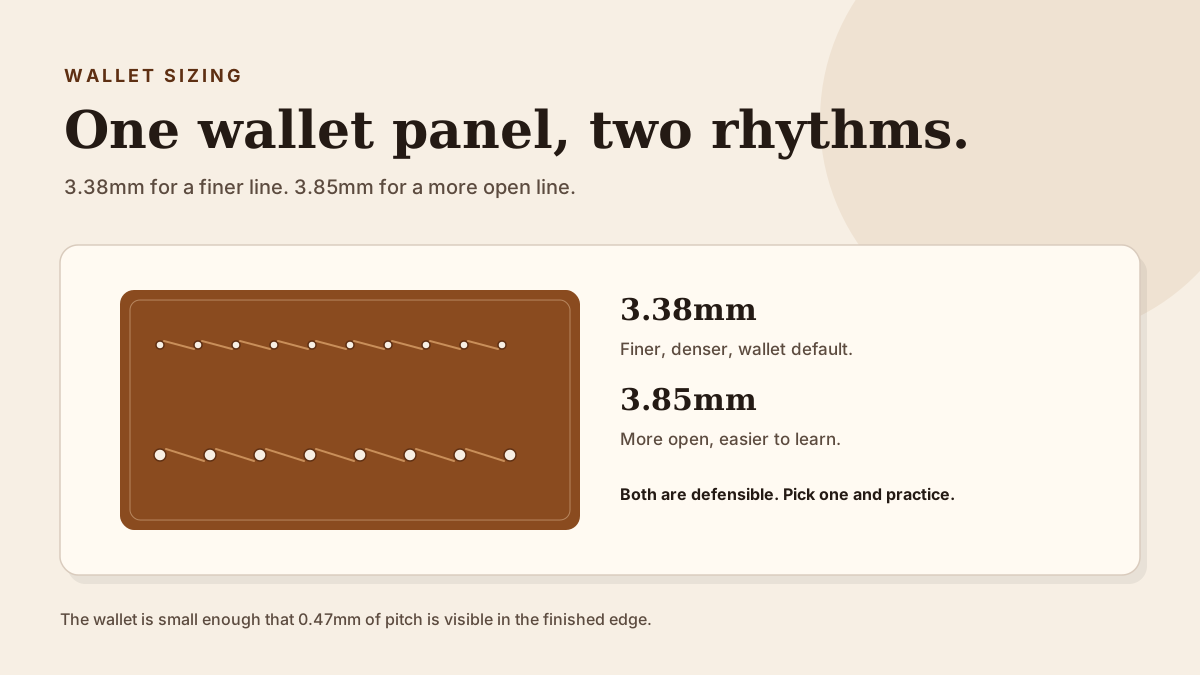
Asking what size pricking irons for wallets? The short answer is 3.38mm (7.5 SPI) for most wallet and cardholder work. 3.85mm (6.6 SPI) is equally usable — more open, easier to learn on, and happier with thicker thread — while 3.0mm gives the most refined line. Pick one pitch in 2-tooth and 8-tooth versions; that pair covers straight runs and corners.
Research-based: crafter threads from 2021–2026, published sizing tables, and AliExpress data verified November 7, 2026. We have not bench-tested these tools.
Quick Answer: What Size Pricking Irons for Wallets?
- Default wallet pitch: 3.38mm — the most common small-goods choice, and the easiest to pair with fine thread.
- Choose 3.85mm for a first iron, 0.55–0.8mm thread, or projects that drift toward bags.
- Choose 3.0mm for the finest line, with thin thread and small holes.
- Watch straps are the exception: drop to 2.7–3.0mm.
Affiliate disclosure
Awl & Stitch is reader-supported. If you buy through links on this page, we may earn a commission at no extra cost to you. We never accept payment for rankings. How we make money
What the Evidence Says About Wallet Pitch
On a bag, the stitch line is a detail. On a wallet, it is a large share of the visible surface, so spacing sets the rhythm of the whole piece. Tighter pitch reads denser and more formal; longer pitch reads more open and casual.
The hard evidence is thin. In a May 2023 r/Leathercraft thread (138bgfl), a crafter with a large Instagram following said roughly 90% of the wallet makers in their survey used 3.38mm, 3.85mm, or 4mm. That is one crafter's survey with an unspecified sample — not industry data — but it shows how narrow the range is.
Kevin Lee Tools' spacing table pairs 1.2–2.2mm wallet leather with 2.7–3.38mm pitches, which supports 3.38mm as the wallet default.
3.38mm vs 3.85mm for Wallets
Pick 3.38mm when the wallet is the point. It looks finer, uses less thread per stitch, and is the common one-size answer for small goods.
Pick 3.85mm when the wallet is one project among many. The holes accept heavier thread, the spacing is more forgiving while you learn tension, and it remains fine for wallets — a February 2026 r/Leathercraft thread (1r5pcdg) says so directly, and a December 2021 thread (rs7l7z) pairs it with thread at or under 0.55mm. Our 3.38mm vs 3.85mm pricking irons comparison has the full trade-off, and the pricking iron size chart converts every common pitch to SPI.
What Thread to Pair With It
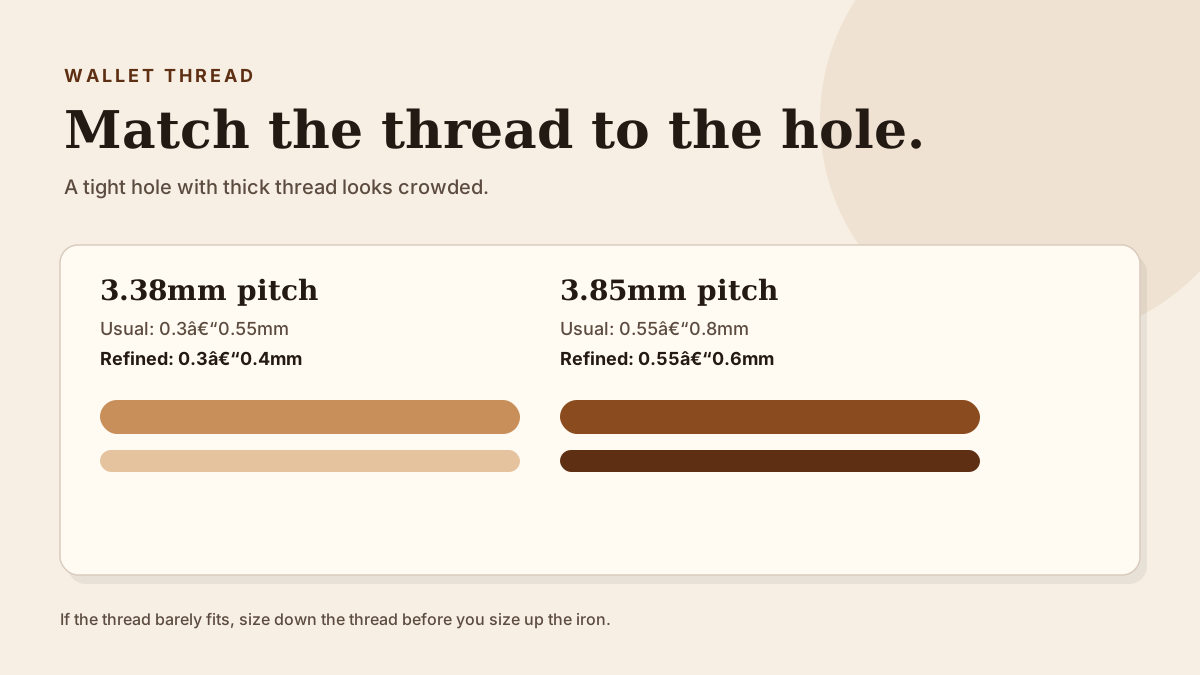
Thread is where the pitch decision becomes visible.
| Pitch | Usual thread range | For a refined wallet |
|---|---|---|
| 3.38mm | 0.3–0.55mm | 0.3–0.4mm |
| 3.85mm | 0.55–0.8mm | 0.55–0.6mm |
These are conventions, not rules. In the 2023 Sinabroks sizing thread (14ir83d), a commenter pairs 3.38mm with 0.3–0.4mm thread, and Vinymo #5 comes up repeatedly in wallet discussions. If your thread barely fits the hole, size down the thread before you size up the iron — hole clearance changes the look more than 0.47mm of pitch does.
How Many Teeth for Wallet Work?
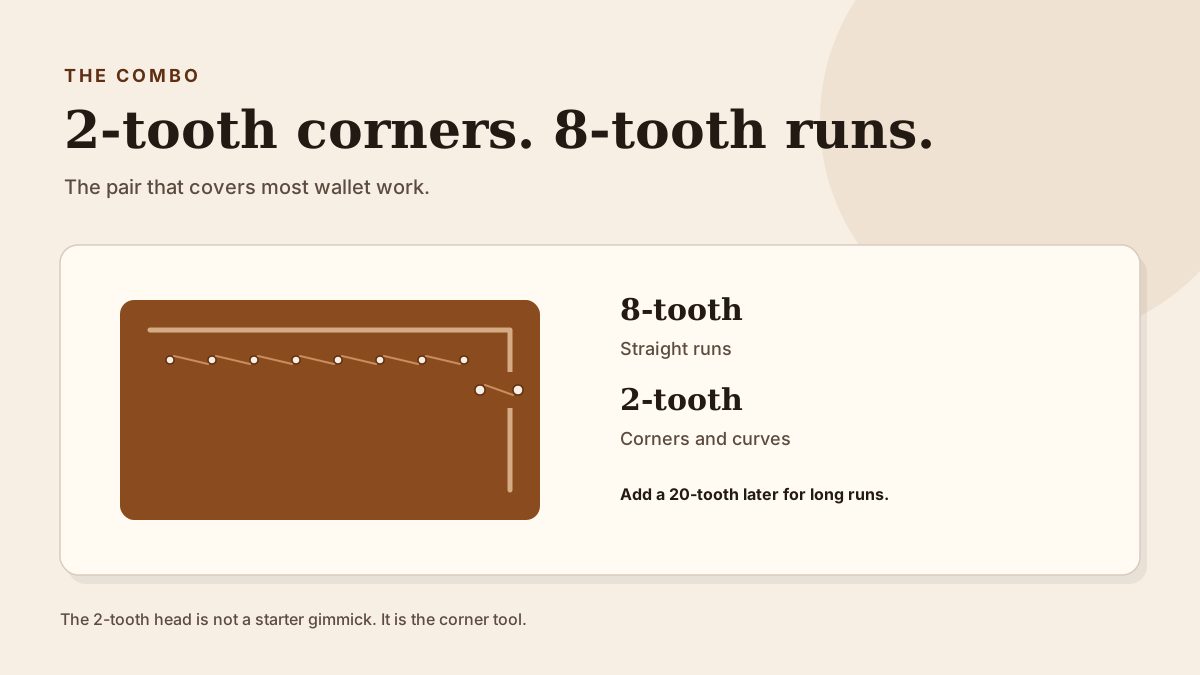
A beginner needs two tooth counts, not five.
- 8 teeth for straight panel runs: bifold top edges, cardholder slots, passport panels.
- 2 teeth for corners, curves, and the last stitch or two before an edge.
- 5 teeth (optional) for medium runs and gentler curves.
- A single tooth helps in tight corners, but it is a later addition.
The practical beginner set is 2 + 8 in one pitch. A 20-tooth iron is a long-run tool for straps and long panels — useful on a long wallet or clutch, unnecessary on a cardholder.
Do You Need Reverse (Obverse + Reverse) Irons for Wallets?
An obverse iron slants its teeth one way; a reverse iron slants the other. Many lined wallets are punched from one side, so obverse alone is often enough.
You need a reverse iron when the angled holes must match on both faces: unlined wallets, edge-visible constructions, or pieces where the stitch slant should meet at the center. In a May 2024 r/Leathercraft thread (1cy6dfu), user Dr_JA put it plainly: beginners do not need a reverse set.
The WUTA listing sells obverse and reverse as separate variants, so adding a reverse later is a checkout choice, not a new tool purchase.
Cardholders, Passport Holders, Watch Straps
Cardholders are wallet work at a smaller scale: 3.38mm is the safe default, and 3.0mm refines the line if you are comfortable with thinner thread. Passport holders follow the bifold logic. Long wallets and clutches can use either pitch; longer runs reward an 8- or 20-tooth iron.
Watch straps are the one place to size down. A June 2022 r/Leathercraft thread (vnnusc) puts them at 3.0mm or 2.7mm; at 3.38mm and above, the line can look coarse on an 18–20mm strap.
| Wallet project | Recommended pitch | Thread pairing | Teeth combo | Notes |
|---|---|---|---|---|
| Bifold wallet | 3.38mm (3.85mm for thicker thread) | 0.3–0.55mm | 8 + 2 | Standard build |
| Cardholder | 3.38mm; 3.0mm for a finer look | 0.3–0.4mm | 8 + 2 | Many corners |
| Passport holder | 3.38mm | 0.3–0.55mm | 8 + 2 | Bifold logic |
| Long wallet / clutch | 3.38mm or 3.85mm | Match the pitch | 8 + 2; 20 optional | Long runs |
| Watch strap | 2.7–3.0mm | Fine thread; check hole clearance | 2 + 8 | Size down |
Recommended Wallet Setup on a Budget
One listing covers the whole setup. The WUTA 1-piece French-style iron (listing 32856254322) sells 2.7, 3.0, 3.38, and 3.85mm pitches, obverse or reverse, in 2, 5, or 8 teeth — roughly 38 variants.
| Variant to choose | What it covers |
|---|---|
| 3.38mm, 2 teeth, obverse | Corners, curves, tight finishing |
| 3.38mm, 8 teeth, obverse | Straight panel runs |
| 3.38mm, 5 teeth, obverse (optional) | Medium runs and gentle curves |
The default variant ("Obverse 3.0mm 2teeth") is $14.79 at time of writing (verified November 7, 2026), but that is not the 3.38mm pair. Variant prices differ by pitch and tooth count, so check the total for the variants you select. Shipping: free USPS from a US warehouse, 3–10 days.
Check the variant menu on AliExpress — pick 3.38mm in 2-tooth and 8-tooth (affiliate link, opens in a new tab) Price verified Nov 7, 2026 — variant prices differ by pitch and tooth count, and prices may change.
For long bifold or clutch runs, the WUTA 20-tooth iron (listing 1005005065670235) is $103.19 at time of writing (verified November 7, 2026), with free standard shipping in 5–13 days and 3.0/3.38/3.85mm variants; prices may change. It is an upgrade, not a first buy: check the listing (affiliate link, opens in a new tab).
On a tight budget? Our best budget pricking irons guide covers the same listing and its landed cost.
FAQ
What size iron do most wallet makers use?
3.38mm is the usual starting point. Roughly 90% of wallet makers in one crafter's Instagram survey used 3.38mm, 3.85mm, or 4mm, per a May 2023 r/Leathercraft comment (138bgfl). The sample is unspecified — directional, not industry data.
Is 3.85mm too big for wallets?
No. A February 2026 r/Leathercraft thread (1r5pcdg) says 3.85mm is fine for wallets and small goods, and a December 2021 thread (rs7l7z) pairs it with thread at or under 0.55mm. It is the easier first iron: larger holes tolerate imperfect tension.
Which size looks most refined?
3.38mm, and 3.0mm if you want to go finer. The difference is small — one 2023 r/Leathercraft thread calls it "tenths of millimeters" — and hole size and thread weight change the look more than pitch alone.
What thread should I use for wallet stitching?
Start with 0.3–0.4mm for a refined look on 3.38mm, up to 0.55mm for a fuller stitch. With 3.85mm, 0.55–0.6mm is common, up to 0.8mm for a heavier look. Vinymo #5 comes up repeatedly. If the thread barely passes the hole, go thinner.
Do I need obverse and reverse irons?
Not as a beginner. A May 2024 r/Leathercraft answer from Dr_JA (1cy6dfu) says beginners do not need a reverse set. Add one only when you need matching angled holes on both faces — unlined wallets or edge-visible work.
Sources
- r/Leathercraft threads: 138bgfl (opens in a new tab) (May 2023, 90% survey comment), 1r5pcdg (opens in a new tab) (Feb 2026, 3.85mm for wallets), 1sszmb1 (opens in a new tab) (Apr 2026, beginner pitch advice), 14ir83d (opens in a new tab) (Jun 2023, 3.38mm thread pairing), rs7l7z (opens in a new tab) (Dec 2021, 3.85mm + thread), vnnusc (opens in a new tab) (Jun 2022, watch-strap sizes), 1cy6dfu (opens in a new tab) (May 2024, reverse-iron answer) — all accessed November 7, 2026
- Kevin Lee Tools spacing table — wallet leather thickness and pitch context (accessed November 7, 2026)
- Borderland Leather sizing intro — project-size guidelines (accessed November 7, 2026)
- AliExpress listing 32856254322 (affiliate link, opens in a new tab) — variant menu, default-variant price, US-warehouse USPS shipping (accessed November 7, 2026)
- AliExpress listing 1005005065670235 (affiliate link, opens in a new tab) — price, variants, standard shipping (accessed November 7, 2026)
Last updated: November 7, 2026. Changelog: Nov 7, 2026 — first publish; verified variant pricing and shipping for both featured listings.