Part of: best pricking irons for beginners.
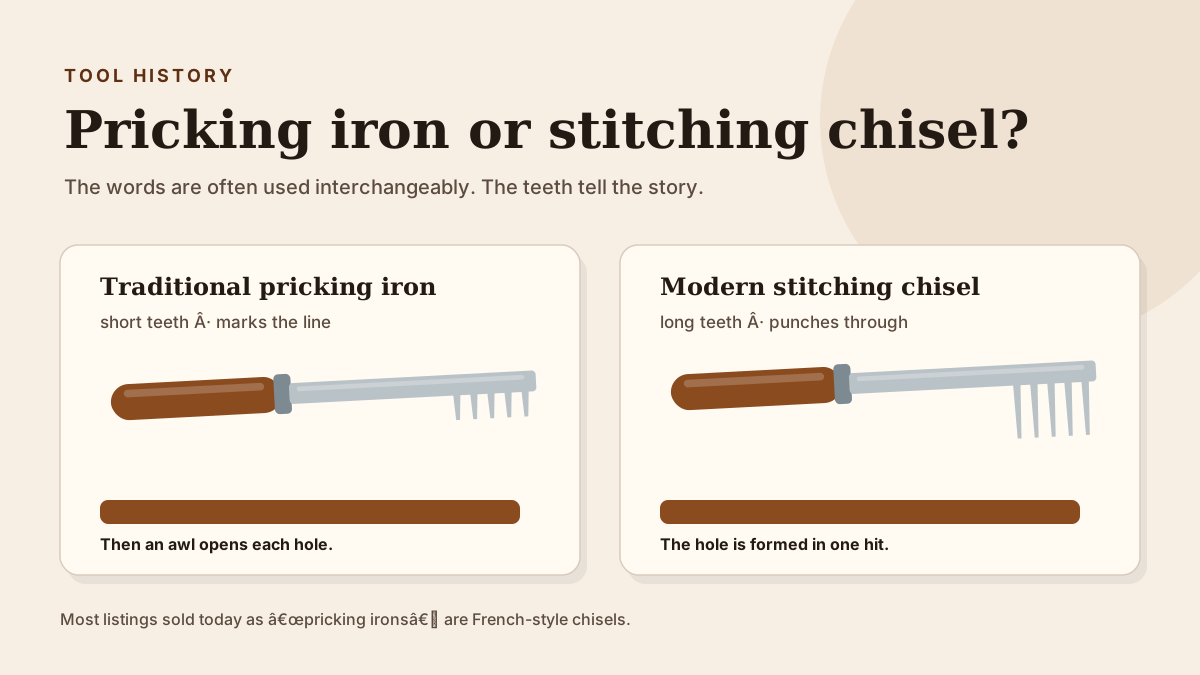
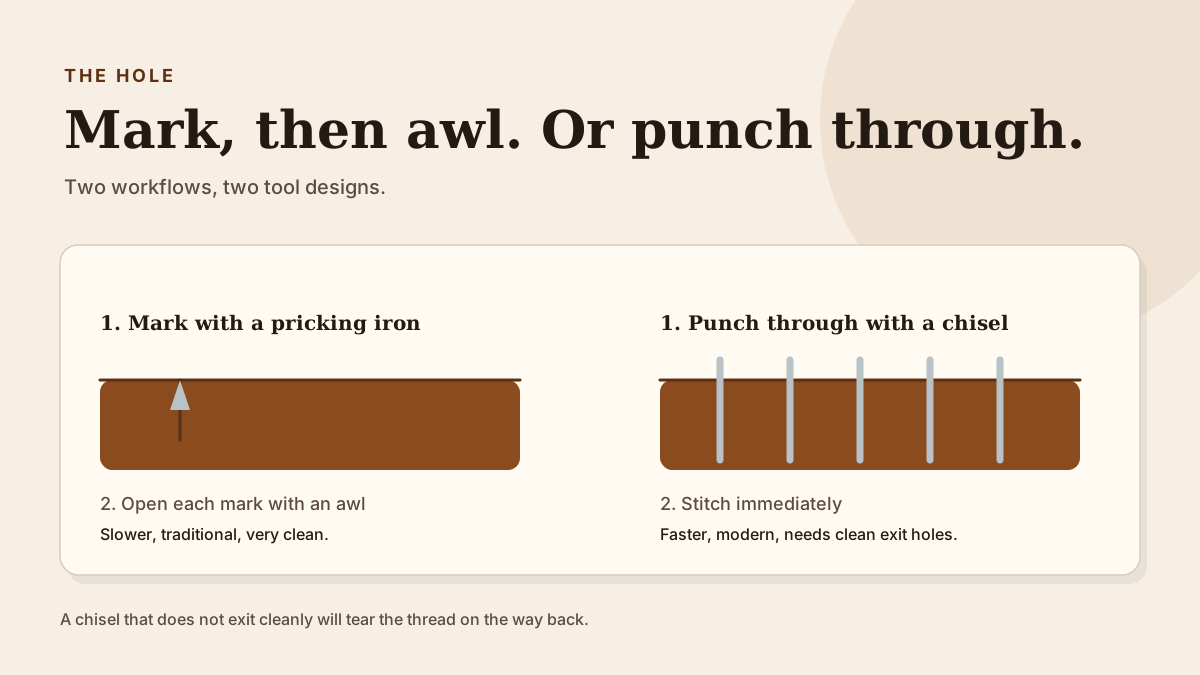
For a US beginner buying today: modern "French-style pricking irons" punch all the way through the leather, so you do not need an awl. Traditional pricking irons only mark the stitch line for an awl to follow, and stitching chisels always punch. In 2026 listings the three names overlap so badly that the title on the product page is the least reliable signal — the tooth photo tells you what the tool actually does. This page untangles the terms, then answers the real question: which one should you buy first?
Everything here is research-based: cited r/Leathercraft threads from 2018 to 2026, a published review from a respected maker, and listing data verified November 7, 2026. We claim no bench time.
Affiliate disclosure
Awl & Stitch is reader-supported. If you buy through links on this page, we may earn a commission at no extra cost to you. We never accept payment for rankings. How we make money
Quick Answer
- Modern French-style pricking iron: punches through; no awl needed; the slanted tooth geometry produces the European angled stitch line. This is what most "pricking iron" listings actually are.
- Traditional pricking iron: marks only; an awl opens each hole. Rare in mainstream listings today.
- Stitching chisel (diamond): punches through; straight 4-prong diamond geometry; usually the cheapest entry.
- Beginner verdict: a French-style 2+8 iron set. It removes awl skills from the learning curve and produces the stitch look most small-goods makers want.
The Terms, Historically
The confusion is old — a 2018 r/Leathercraft thread titled "irons, chisels or iron chisels?" asks the same question that threads still ask in 2026. Historically, a pricking iron marked a row of guide holes and a stitching awl opened each one; a chisel punched the hole outright. That line has blurred: the top comment on an October 2025 r/Leathercraft thread ("Someone explain pricking irons vs. chisels like I'm 5"), from a maker specializing in leather goods, states that "terms are mostly interchangeable at this point" and that anything you buy "without specifically seeking those out will be suitable to punch all the way through."
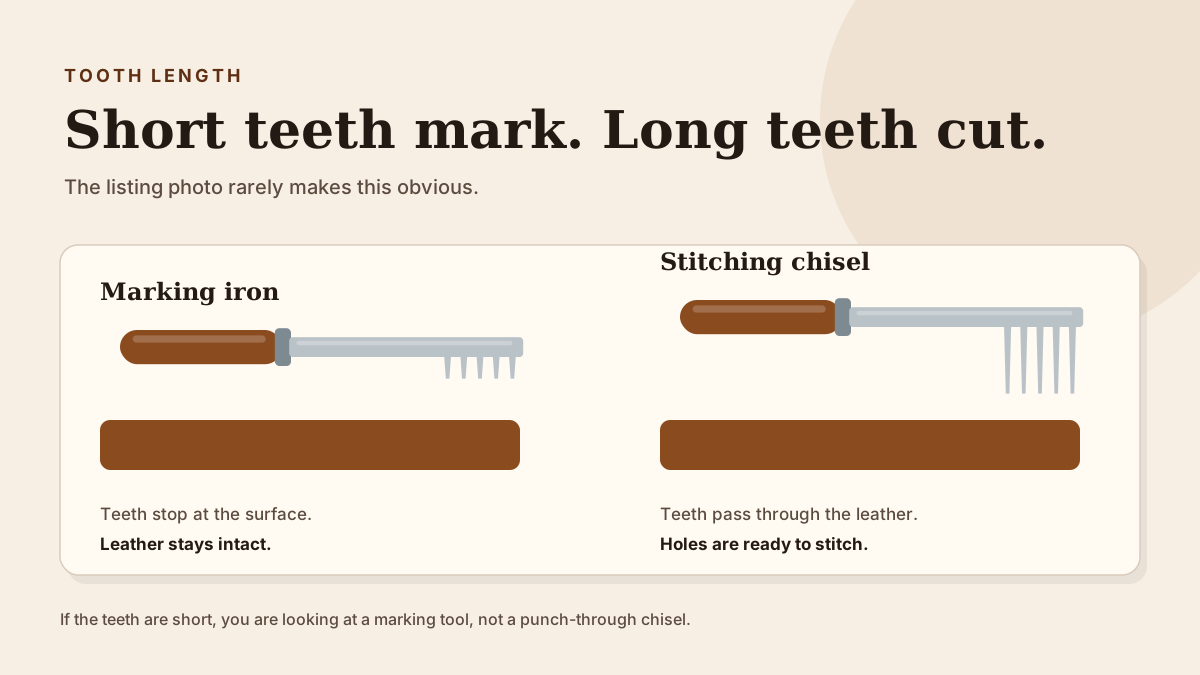
Sellers reinforce the blur. Listings labeled "pricking iron" routinely show punch-through chisel geometry, and "French-style chisels" exist too. The practical rule: judge the tool by its tooth photo and description, not its name. Slanted, fine, French-style teeth at 2–8 counts usually mean a punch-through French-style iron; straight diamond teeth mean a chisel.
Side-by-Side: Pricking Irons vs Stitching Chisels
| Traditional pricking iron | Modern French-style iron | Diamond stitching chisel | |
|---|---|---|---|
| What it does to leather | Marks guide holes only | Punches clean slanted holes through | Punches diamond holes through |
| Needs an awl? | Yes | No | No |
| Hole character | Smallest holes (awl-governed) | Small, slanted, consistent | Larger diamond holes |
| Stitch look | Classic hand-sewn (with awl) | Angled European fine-leatherwork look | Straight, slightly rustic diamond line |
| Best leather thickness | Any (awl opens what it marks) | Most; check tooth length for heavy stacks | Most; short teeth struggle on thick stacks |
| Beginner friendliness | Low — requires awl skill | High | High |
| Typical price tier | Niche/collector territory | ~$15–$40 on AliExpress (verified Nov 2026) | Cheapest entry tier |
| Example listing | — | WUTA 1-pc French-style, $14.79 — Check price on AliExpress (affiliate link, opens in a new tab) | Generic — see picks on our hub |
Price verified November 7, 2026 — they change often.
Buy by project
| Project | Recommended tool family |
|---|---|
| Wallets / small goods | French-style iron, 3.38 or 3.85mm, 2+8 teeth |
| Belts / straps | French-style 20-tooth iron |
| Bags / heavy goods | Chisels or French-style irons with long teeth — check tooth length |
| Watch straps | Fine French-style iron, 2.7–3.0mm |
The Real Trade-Off: Hole Size and Stitch Strength
This is the depth most forum answers skip. In his January 2020 pricking iron review, leatherworker Nigel Armitage (Armitage Leather) argues that the traditional method — pricking iron to mark, awl to open — produces the smallest hole and therefore the strongest stitch, because the thread is gripped by the least-disturbed leather. A punched hole is bigger by design; the trade is speed and consistency.
His published opinion matters most on heavy goods — belts, bag handles, bridle work — where stitch strength is structural. On wallets and cardholders, the difference is negligible for hobby work, and punch-through irons remove the single biggest source of beginner error: mis-aimed awl holes. That is why our beginner verdict favors punch-through French-style irons despite the theoretical strength argument.
One practical check either way: tooth length. In a June 2022 r/Leathercraft thread, a commenter warns that "some stitching chisels teeth are too short to go all the way through thick leather." Kevin Lee Tools' spec sheets list tooth lengths around 8–10mm — if your leather stack approaches that depth, read the spec before buying.
Diamond Chisels vs French-Style Irons
The geometry difference is aesthetic before it is functional:
- Diamond chisels: straight 4-prong heads that leave a diamond-shaped hole and a straight, slightly rustic stitch line. They are the cheapest way to start saddle stitching.
- French-style irons: slanted teeth at roughly a 45° angle that leave a fine, angled hole — the look associated with European fine leatherwork and premium small goods.
You can get the French slanted look from a "chisel": French-style chisels exist, which is exactly why the 2021–2022 r/Leathercraft threads ("Newbie: Pricking iron vs Stitching chisel?" and its successors) keep circling the same answer — look at tooth geometry, not the label. Brands that come up in these discussions include KS Blade, Sinabroks, and Kyoshin Elle on the premium side, with AliExpress sellers covering the budget tier.
How Deep Do You Punch?
Until the teeth break cleanly through the back of the leather — the advice given to a first-time French iron owner in a September 2024 r/Leathercraft thread. Stopping short leaves scored marks that the thread catches and tears on the next stitch. Two cautions from the same community threads: triangular teeth can widen holes if you over-punch, and many-tooth tools need more force per press — a reference guide from One & Awl notes the force scales with tooth count, which is why 20-tooth irons want a solid surface and a confident mallet strike.
If your irons stick in the leather, that is a burr and polish problem, not a technique problem — see the next section.
For a full walkthrough of angle, spacing, and mallet work, a dedicated how-to-use guide is coming soon.
Which Should You Buy First?
Buy a French-style 2+8 punch-through iron set first. It is the fastest path to consistent saddle stitching on wallets and small goods, and it needs no awl skills. Our top pick from the verified listings is the WUTA 1-piece French-style iron — $14.79 for the default variant at time of writing (verified November 7, 2026), with 2.7–3.85mm pitches and 2/5/8 teeth as variants, and free USPS shipping from a US warehouse in 3–10 days.
👉 Check price on AliExpress (affiliate link, opens in a new tab) Prices verified November 7, 2026 — they change often.
Buy diamond chisels instead if you want the absolute cheapest entry or prefer the straight diamond stitch look. Buy both styles in one system if you already know you want to experiment: the WUTA interchangeable-head set (listing 1005008415646222) pairs chisel and French-style heads on one handle — $8.33 for the default single head at time of writing (verified November 7, 2026), with the full set running about $162 per our November 6, 2026 conversion, and the only 90-day free-return terms among the listings we verified. Early buyers in a May 2025 r/Leathercraft thread called the head fit fiddly but praised the small hole size.
👉 Check price on AliExpress (affiliate link, opens in a new tab) The $8.33 price is the default single head, not the full set — verified November 7, 2026.
On a strict budget? Our best budget pricking irons guide ranks the under-$30 tier with verified shipping. And whichever family you buy, get the pitch right: 3.38mm for small goods, 3.85mm for larger work — the pricking iron size chart converts every size to SPI.
FAQ
Are pricking irons and chisels interchangeable today?
Functionally, mostly yes. The top comment on the October 2025 r/Leathercraft ELI5 thread says the terms are now mostly interchangeable and that irons bought without specifically seeking out a traditional marker will punch all the way through. Traditional mark-only irons still exist, but they are the minority of listings.
Do pricking irons require an awl?
Traditional ones do — they only mark. Modern French-style pricking irons do not; they punch the hole as they go, which is the consensus in the 2021–2022 r/Leathercraft comparison threads. Read the listing description and tooth photo: if the teeth look like fine slanted blades, it punches.
Which makes a smaller, stronger stitch?
The traditional iron-plus-awl method, per Nigel Armitage's January 2020 review: the awl opens the smallest hole, disturbing the least leather, which grips the thread best. He presents this as his published opinion, and it matters mainly on heavy goods. On wallets, the difference is negligible and punch-through consistency wins for beginners.
Some chisel teeth are too short for thick leather — how do I know?
Check the tooth length spec before buying. A June 2022 r/Leathercraft commenter warns that some chisel teeth are too short to punch through thick stacks, and Kevin Lee Tools lists tooth lengths of roughly 8–10mm. If your stack (say, two layers of 4–5oz leather) approaches the tooth length, step up to a longer-tooth tool or reduce the stack.
Why do my irons stick in the leather?
Burrs or unpolished teeth, per an August 2026 r/Leathercraft thread on the problem. The reported fixes: polish the teeth, run them across beeswax, or use the metal-plate trick — striking through into a sacrificial plate to burnish the burrs down. A dedicated guide on how to polish pricking irons, with the full fix list, is coming soon.
Can I get the French slanted look with a chisel?
Yes — French-style chisels exist, which is why the 2021–2022 threads keep saying the labels are loose. Judge the tooth geometry in the listing photo: slanted fine teeth produce the French look regardless of what the title calls the tool.
Verdict
The names have blurred, but the decision has not: a French-style punch-through iron (2+8 teeth) is the right first buy for beginners making wallets and small goods — no awl, consistent slanted holes, $14.79 verified on November 7, 2026. Diamond chisels are the cheaper, more rustic alternative; the traditional iron-and-awl method is a craft-depth pursuit best taken after your first dozen projects.
Sources
- r/Leathercraft threads: 1nwn4of (opens in a new tab) (Oct 2025, ELI5 thread + top comment), l3emcn (opens in a new tab) (2021), pzqkgm (opens in a new tab) (2021), vnnusc (opens in a new tab) and vnq97u (opens in a new tab) (2022), a23zrc (opens in a new tab) (2018), 1f8l74f (opens in a new tab) (Sep 2024, punch depth), 1vk80vr (opens in a new tab) (Aug 2026, sticking) — all accessed November 7, 2026
- Armitage Leather pricking iron review PDF (January 2020) — hole size/strength trade-off (accessed November 7, 2026)
- Borderland Leather intro (2022) — terminology and sizing (accessed November 7, 2026)
- One & Awl reference (2024) — tooth counts and force for many-tooth tools (accessed November 7, 2026)
- LeatherCraftHaven chisels guide (June 12, 2026) — SPI/pitch framing (accessed November 7, 2026)
- Kevin Lee Tools spec page — tooth lengths 8–10mm (accessed November 7, 2026)
- AliExpress listings 32856254322 (affiliate link, opens in a new tab) and 1005008415646222 (affiliate link, opens in a new tab) — prices and shipping (accessed November 7, 2026)
Last updated: November 7, 2026. Changelog: Nov 7, 2026 — first publish; verified pricing for both featured listings.